
PEACE OFFICER
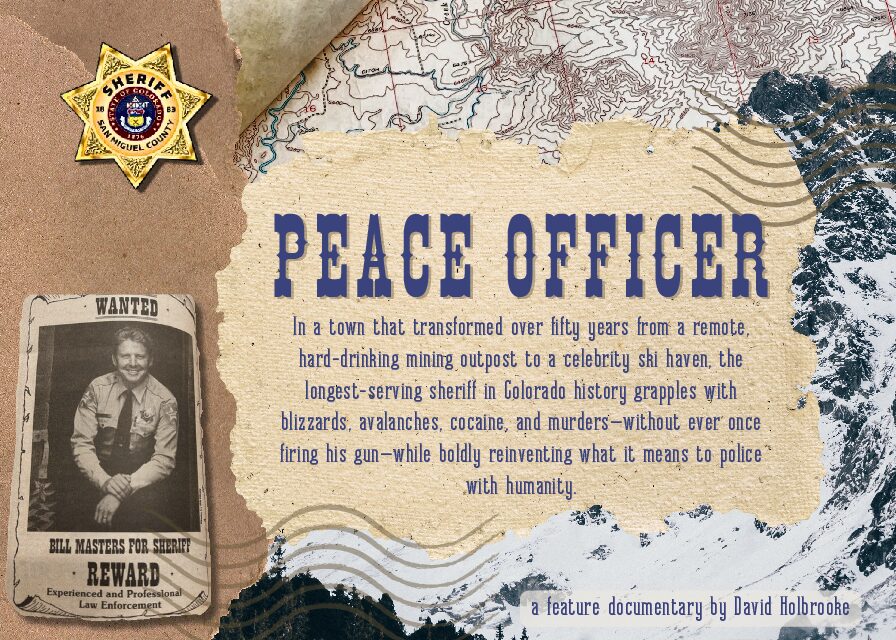
Directed by David Holbrooke
Produced by David Holbrooke, Christi Cooper
Logline: In a town that transformed over fifty years from a remote, hard-drinking mining outpost to a celebrity ski haven, the longest-serving sheriff in Colorado history grapples with blizzards, avalanches, cocaine, and murders—without ever once firing his gun—while boldly reinventing what it means to police with humanity.
Summary:
A Valley Boy rolls into Telluride in 1974 with $20, a VW Bug, and one plan: ski. The town has other ideas. Shanghaied into Town Marshal at 25, Bill Masters is suddenly responsible for keeping the peace between old-guard miners and a new wave of outsiders chasing powder and freedom. He keeps getting elected—again and again—and spends the next 50 years patrolling 1,200 square miles of rugged San Miguel County, from high desert to lethal mountain passes. Along the way he confronts avalanches, blizzards of cocaine, a serial killer, cult deaths, and the mysterious murder of a U-Hall heiress—without ever firing his gun in action. Once a hardline drug warrior, Masters comes to believe the War on Drugs did more harm than the drugs, and he redefines himself as a “peace officer.” Riding into retirement, he leaves one question: is there a more human way to police?
WHY THIS FILM AND WHY NOW?
As policing debates harden into slogans, Bill Masters offers something increasingly rare: a lived, complicated, decades-long perspective from inside a rural sheriff’s office—one that includes real danger, real consequences, and a public change of heart. His retirement closes a chapter not only on a singular career, but on an older model of community-based peacekeeping that’s being replaced by technology, militarization, and national politics. This film isn’t arguing from theory; it’s asking the question from the trail.
From learning to keep the peace in a volatile mining town undergoing a cultural collision; confronting the drug wars as “a cloud of drugs settled over Telluride”; navigating life-and-death mountain emergencies across roughly 1,200 square miles of high desert and dangerous passes; and ultimately reckoning with how policing changed—toward tactics, technology, and politics—while community trust eroded nationwide, Masters’ reckons with his long career and the question of whether there is a more human way to police in the 21st century.
WHAT YOUR DONATION COULD SUPPORT:
These are some examples of real costs associated with making this film, and this only represents a portion of our overall budget, but it will give you a sense of very specific milestones that your contribution could support:
$100K – editor
$70K – graphics and animation with an award-winning team – this will significantly elevate the production quality and ability to tell the story cohesively with such a great volume of archival material
$50K – hiring our film crew for production
$40K – hiring a composer and musicians to create and record an original score
$30K – licensing A Touch of Grey (Grateful Dead) – or – Smuggler’s Blues (Glenn Frye) – both of which are essential to the story
$30K – professional post-production sound design and mixing
$20K – legal fees
$15K – licensing archival materials
$13K – insurance
$10K – graphic elements for launch of film (poster design, etc.)
$2K – accounting
Throughout this entire project, we have been dedicated to keeping the project 100% Colorado-made, prioritizing Colorado-based crew and vendors for editorial, finishing, graphics/animation, music, legal, and accounting to ensure the film’s creative and economic impact stays local.
Peace Officer Donation Form
"*" indicates required fields